Level 011864 – 1880Silver Bow Creek
Gold in Silver Bow Creek
Before it was a mining camp, the valley under the Big Butte was hunting ground, crossed by the Shoshone, the Salish and the Blackfeet.
In 1864 two prospectors, G. O. Humphrey and William Allison, washed placer gold out of Silver Bow Creek. A rough camp of tents and log cabins followed, named for the bald, cone-shaped hill to the northwest that settlers called the Big Butte.
The placer gold played out fast. By the early 1870s the camp had shrunk to a few hundred people and was headed for the long list of Montana ghost towns. Then the hard-rock men found silver. In 1875 William Farlin worked the Travona lode and built a mill, and the camp came back to life.
Butte incorporated in 1879. In 1881 the Utah & Northern Railway rolled in, tying the camp to the transcontinental line and to eastern money. By then a few men had noticed something in the rock worth more than silver.
Level 021881 – 1899The Anaconda claim
A vein of copper
The Anaconda was bought as a silver mine. A few hundred feet down it turned into the greatest copper deposit of its age.
In 1881 Marcus Daly, an Irish-born mining man who could read rock, bought a small silver claim called the Anaconda with backing from San Francisco investors James Ben Ali Haggin, Lloyd Tevis and George Hearst. As the shaft went down, the silver gave way to copper sulfide ore of staggering richness.
The timing could not have been better. Edison's light bulb and Bell's telephone needed copper wire by the mile, and America was about to electrify. Daly kept quiet, bought up the neighboring claims, and in 1883 fired a smelter 26 miles west in a company town he named Anaconda.
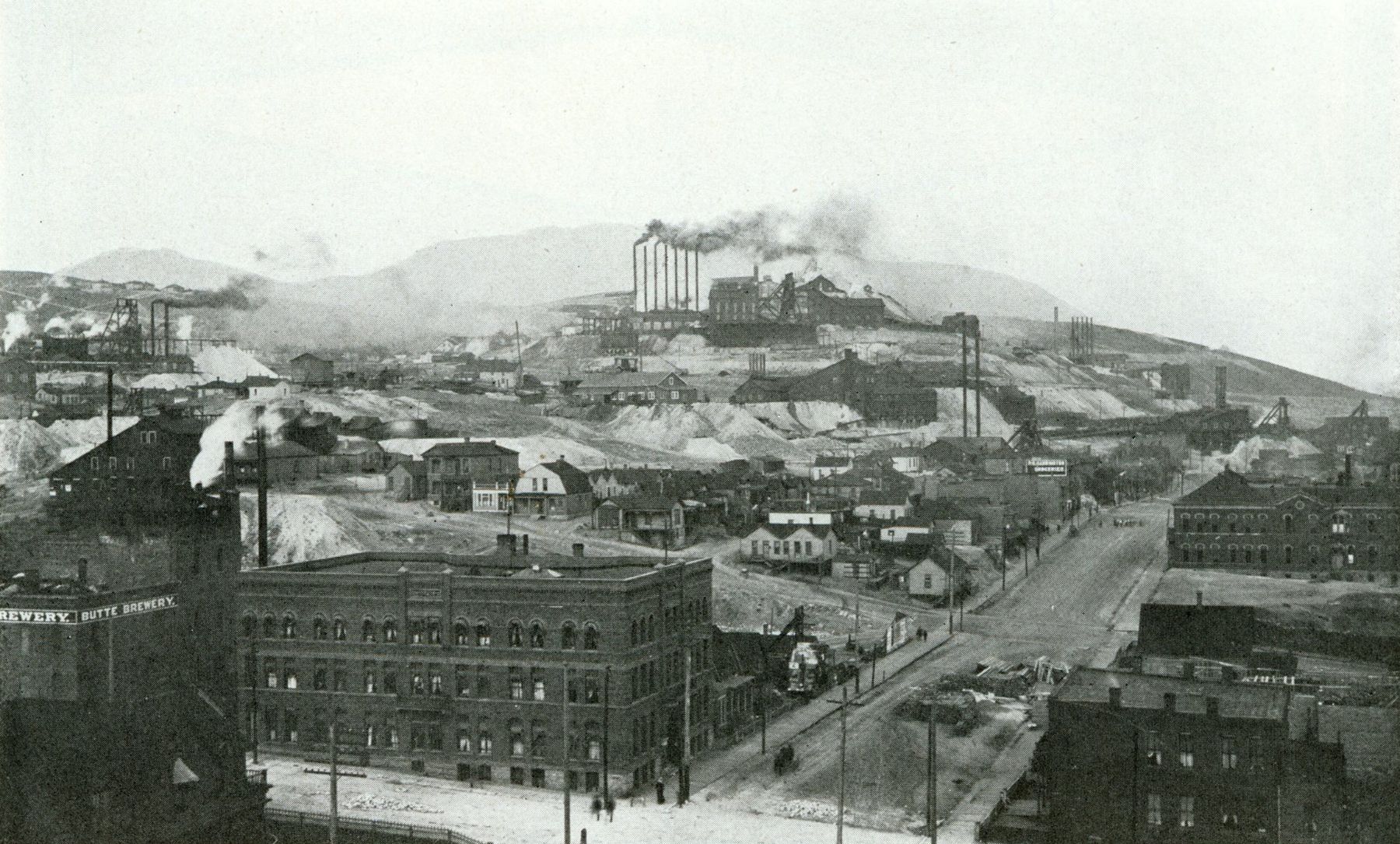
By the late 1880s Butte had passed Michigan as the nation's top copper producer. For a time the hill turned out roughly a third of the world's copper. Headframes rose on every slope, sulfur smoke from open roast heaps hung over the streets, and the boosters' phrase stuck: the Richest Hill on Earth.
The hill, inside out
Tailings at the Mountain Consolidated, whose shaft would eventually reach more than a mile below the surface.
Level 031888 – 1906The War of the Copper Kings
The Copper Kings
Three men fought over the hill, and over Montana itself, with money, lawyers and newspapers.
William Andrews Clark came as a merchant and banker and built a fortune in mines, smelters, water works and streetcars. Marcus Daly ran the Anaconda. They despised each other. When Montana voted on a permanent capital in 1894, Daly spent heavily for Anaconda; Clark backed Helena, and won.
In 1899 the legislature sent Clark to the U.S. Senate. A Senate committee found his campaign had bribed lawmakers, and he resigned in 1900 before he could be thrown out. He was elected again in 1901 and served a full term. Daly did not live to see it. He died in November 1900, a year after his Anaconda was folded into the Amalgamated Copper Company, a trust run by Standard Oil's Henry H. Rogers and William Rockefeller.
The third king was F. Augustus Heinze, a young engineer who used the "apex law" to argue that rich veins under his rivals' ground surfaced on his own. Friendly local judges tied Amalgamated up in more than a hundred lawsuits. In 1903 Amalgamated shut down nearly all of its Montana operations, putting thousands out of work, until the governor called a special session to pass a law that cut Heinze's judges out. Heinze sold out in 1906 for a reported $10.5 million.
What was left was "the Company." Reorganized as Anaconda Copper Mining Company in 1915, it ran Butte's jobs, much of Montana's legislature and most of the state's daily newspapers until the late 1950s.
Clark's gift
A 68-acre park at the foot of the East Ridge, with a pavilion, roller coaster, carousel and flower beds, reached by streetcar. For generations of Butte kids it was the best day of the year. It closed in 1973 to make way for mine expansion.
Level 041890 – 1920Uptown & the camps
A city of many nations
Butte pulled in workers from every mining district in the world, and built a brick downtown fit for a metropolis.
The Irish came first and in the greatest numbers; for a while Butte was one of the most Irish cities in America. Cornish "Cousin Jacks" brought hard-rock know-how from the tin mines. Then came Finns, Serbs, Croatians, Italians, Lebanese, Mexicans, Swedes, and a Chinese community that ran shops and noodle parlors along Galena and Mercury streets.
Each group had its own neighborhood, church, saloons and lodge halls, wedged between the mine yards: Dublin Gulch, Corktown, Finntown, Meaderville, Chinatown, Centerville, Walkerville, McQueen, Dogtown. Estimates put the population of Butte and its camps near 100,000 at the 1917 peak, the biggest city between Minneapolis and Seattle.
Uptown was built for that crowd. Granite, Broadway and Main filled with brick and stone: banks, hotels, department stores, theaters and an opera house. The mines ran three shifts and so did the town. The saloons, cafés and the red-light district on Mercury Street never closed.
The whole camp, 1908
Plate IV · Library of Congress · Keep scrolling →
Panoramic view of Butte and the Summit Valley, 1908.
Level 05Down the shaftLevels to 5,000+ ft
The city underground
Under the streets lay a second Butte: thousands of miles of tunnels, hot and wet, lit by candle and carbide.
Every mine announced itself with a headframe, the steel or timber tower that carried the hoist rope over a sheave wheel and down the shaft. Butte called them gallows frames. Men rode the cage down, stepped off at their level, and worked the stopes with drills and dynamite. Levels were named by depth: the 1,200, the 2,400, the 3,800.
Down deep the rock was hot. On the lowest levels the air could top 100°F, and ventilation fans and ice water were part of the job. Rock dust caused silicosis, "miners' con," which shortened thousands of lives. Falling rock, fire, bad air and the cage itself killed thousands more over the decades.
By common estimate the mines cut some 10,000 miles of shafts, drifts and crosscuts under the city. More than a dozen headframes still stand over Butte as monuments. At night several are lit red.
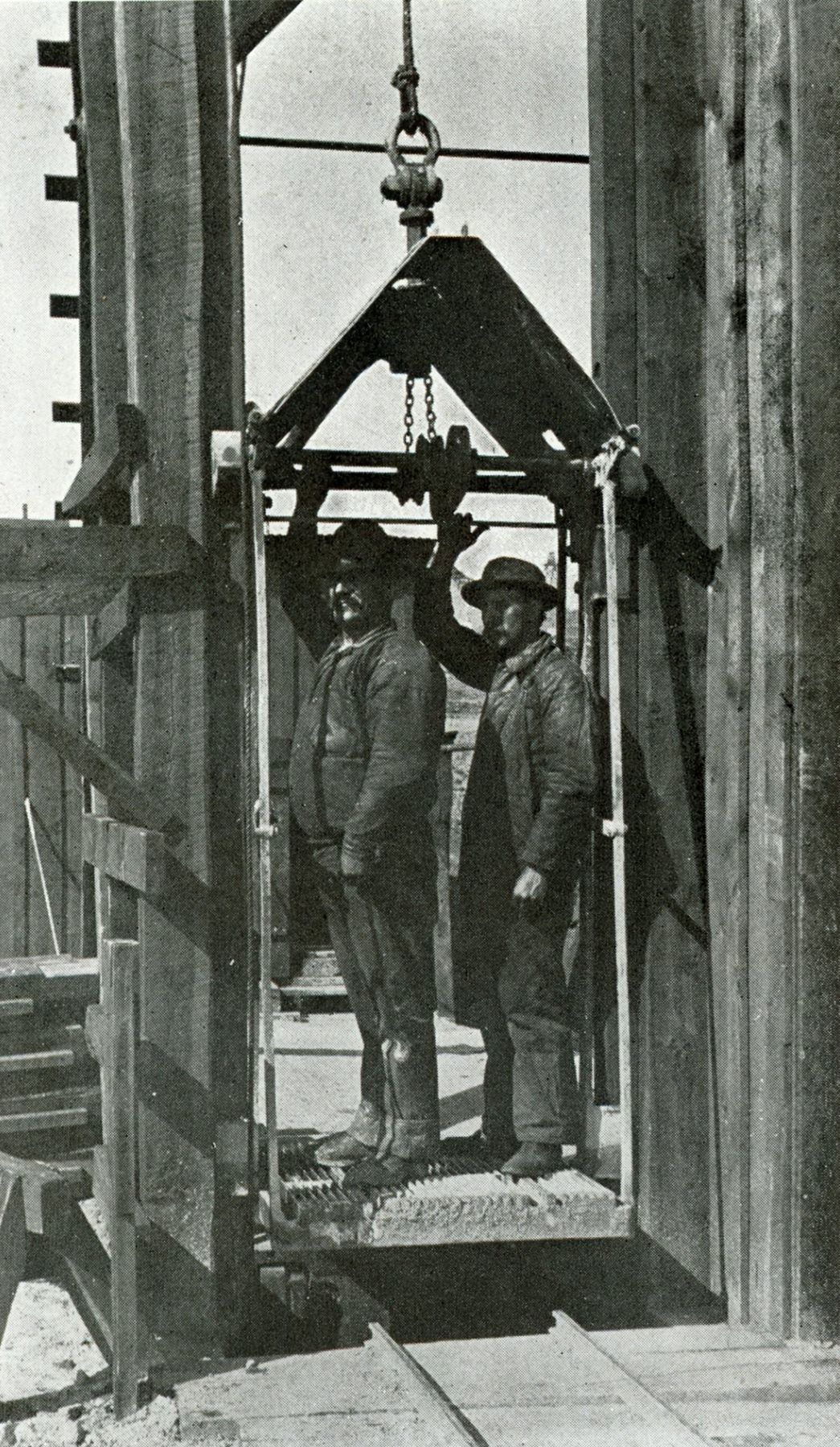
Gallows frame
The Anselmo headframe and tipple, recorded by the Historic American Engineering Record. Library of Congress.
Level 061878 – 1920Butte Miners' Union No. 1
Gibraltar of unionism
Butte was one of the strongest union towns in America. In the 1910s that strength cracked, and then it burned.
The Butte Miners' Union, founded in 1878, won the $3.50 day and the eight-hour shift, and its June 13 Miners' Union Day was a city holiday. Nearly every trade in town organized. Labor called Butte "the Gibraltar of Unionism."
By 1914 many miners believed their union had gotten too cozy with the Company. A revolt split the membership, a riot broke out at the Union Day parade, and on June 23, 1914, the union hall on North Main was dynamited into rubble. The governor sent in the militia and declared martial law.
On the night of June 8, 1917, a miner's carbide lamp lit the frayed insulation of a power cable in the Granite Mountain shaft, 2,400 feet down. Fire and gas raced through the connected workings of the Speculator mine. Many of the dead were found behind concrete bulkheads that had no doors. It is still the deadliest hard-rock mining disaster in American history.
Thousands walked out after the fire. In late July the IWW organizer Frank Little came to Butte to back the strike. Before dawn on August 1, masked men dragged him from his boardinghouse and hanged him from a railroad trestle. A card pinned to his body read "3-7-77," the old vigilante warning. No one was ever charged.
Federal troops patrolled the city off and on until 1921. On April 21, 1920, Company guards fired on picketers on the Anaconda Road, wounding seventeen; Tom Manning died of his wounds. Organized labor in the mines did not fully recover until the 1930s.
Granite Mountain – Speculator fire · June 8, 1917
168 lamps went out
One for each man who died. A memorial overlook now stands above the Granite Mountain shaft in north Butte, with their names.
Level 071920 – 1955Depression & war
A mile high, a mile deep
Copper rose and fell with the world, and Butte rode every swing.
When copper prices crashed in the Depression, the mines laid off thousands and families left. New Deal photographers came to document it. Arthur Rothstein, shooting for the Farm Security Administration in 1939, found a city that still came alive at night under the theater marquees of Uptown.
The Second World War brought the demand roaring back. Shell casings, wire, ships and planes all needed copper, and Butte worked flat out on a thin labor supply. In 1942 Russell Lee photographed a salvage yard heaped with wrecked cars waiting to be melted back into the war effort.
Butte called itself "a mile high and a mile deep," and both were true. But the rich veins were getting deeper and costlier to reach. The Company was already planning another way to take the hill.
Everything into the war
A scrap and salvage depot in Butte, shot on Kodachrome. Library of Congress.
Level 081955 – 1983Open-pit mining
The Berkeley Pit
In 1955 Anaconda started digging the hill from the top down. The pit swallowed the neighborhoods that had grown up around the mines.
Open-pit mining could profitably move low-grade ore by the trainload and truckload. The Berkeley Pit grew year by year until it was more than a mile long and half a mile wide. Meaderville, with its Italian supper clubs, was bought out and dug away, followed by McQueen, East Butte and much of the old East Side. Columbia Gardens closed in 1973.
In 1977 the Atlantic Richfield Company (ARCO) bought Anaconda, just as copper prices sagged and Chile nationalized the company's biggest mines. In 1982 ARCO stopped mining the pit and shut off the pumps that had kept the underground workings dry for a century.
Groundwater, turned acidic and heavy with metals by the old workings, began to fill the hole. In 1983 the area became part of one of the largest Superfund sites in the nation, running down Silver Bow Creek toward the Clark Fork. The water in the pit is now hundreds of feet deep, and treatment plants and monitoring wells are designed to keep it from reaching the valley's groundwater.
Level 091983 – todayButte–Silver Bow
Still Butte
The Company is gone. The city it couldn't do without is still here.
In 1977 the city and Silver Bow County merged into one government, Butte–Silver Bow. Mining came back in 1986, when Montana Resources reopened the neighboring Continental Pit, and it goes on today. Cleanup along Silver Bow Creek has brought back streamside life to water that was dead for most of a century.
In 1985 volunteers set Our Lady of the Rockies, a 90-foot statue, on the Continental Divide above town, lifted into place in sections by a National Guard helicopter. You can see her from almost anywhere in the valley.
In 2006 the Butte–Anaconda Historic District became a National Historic Landmark, one of the largest in the country, with nearly 6,000 contributing buildings and structures. The headframes, the brick blocks of Uptown and the miners' cottages on the hill are what's left of the city that wired America. Every March 17, Uptown fills again.
Visit: World Museum of Mining (Orphan Girl mine yard) · Granite Mountain Memorial · Berkeley Pit viewing stand (seasonal) · Uptown trolley tours (summer)
Butte, Montana · Common questions
Questions about Butte
Why is Butte called the Richest Hill on Earth?
Starting in the 1880s the hill above Butte produced enormous quantities of copper, along with silver, gold, zinc and manganese. By the late 1880s Butte was the leading copper producer in the United States, and at its height it supplied roughly a third of the world's copper. The district is commonly estimated to have produced more than 20 billion pounds of copper.
Who were the Copper Kings?
William Andrews Clark, Marcus Daly and F. Augustus Heinze. Their fights over mines, courts and politics between the late 1880s and 1906 are known as the War of the Copper Kings. Daly's Anaconda company, absorbed by Amalgamated Copper in 1899, became the dominant force in Montana for most of the 20th century.
What happened at the Granite Mountain–Speculator mine in 1917?
On June 8, 1917, a fire broke out 2,400 feet underground in the Granite Mountain shaft and spread through the connected Speculator workings. 168 men died, making it the deadliest hard-rock mining disaster in U.S. history.
What is the Berkeley Pit?
An open-pit copper mine opened by Anaconda in 1955 on Butte's east side. Mining there stopped in 1982 and the groundwater pumps were shut off, so the pit has been filling with acidic, metal-laden water ever since. It is part of a federal Superfund site listed in 1983.
Is Butte a National Historic Landmark?
Yes. The Butte–Anaconda Historic District was designated a National Historic Landmark in 2006. It is one of the largest landmark districts in the country, with nearly 6,000 contributing buildings and structures, including the surviving headframes.
What is there to see in Butte today?
The World Museum of Mining, the Granite Mountain Memorial, the Berkeley Pit viewing stand, Our Lady of the Rockies, the Uptown historic district and its headframes, and one of the biggest St. Patrick's Day celebrations in the Northwest.
Shaft log
Butte timeline
Placer gold found on Silver Bow Creek.
William Farlin works the Travona silver lode.
Butte Miners' Union founded.
Butte incorporated.
Railroad arrives; Daly buys the Anaconda.
Anaconda smelter begins operation.
Amalgamated Copper formed; Clark sent to the Senate; Columbia Gardens opens.
Amalgamated shutdown to break Heinze.
Heinze sells out.
Miners' Union Hall dynamited; martial law.
Granite Mountain–Speculator fire kills 168. Frank Little lynched.
Anaconda Road shooting.
Berkeley Pit opens.
Columbia Gardens closes.
ARCO buys Anaconda; Butte–Silver Bow consolidates.
Pit mining stops; pumps shut off.
Superfund listing.
Our Lady of the Rockies placed.
Continental Pit mining resumes.
National Historic Landmark District.
A mile high.
A mile deep.
Butte, Montana. Founded 1864. Still here.
Photographs
Every image here is in the public domain, apart from the modern Daly statue photo, which is released under CC0. Sources include the Library of Congress (HAER, FSA/OWI), the National Archives, the New York Public Library and Harry C. Freeman's 1900 A Brief History of Butte, Montana, via Wikimedia Commons.
- Plate IButte, Montana, c. 1900 Harry C. Freeman
- Fig. 01Prospectors in Butte Harry C. Freeman, 1900
- Fig. 02Anaconda Mine, Butte Detroit Publishing Co., NYPL
- Fig. 03Smelters at base of Anaconda Hill H. C. White Co., NYPL
- Plate IITailings at Mountain Con., 1906 National Archives
- PortraitWilliam A. Clark Harris & Ewing, Library of Congress
- PortraitMarcus Daly statue Lyumars, CC0
- Plate IIIColumbia Gardens, c. 1900 Harry C. Freeman
- Fig. 04Granite Street, c. 1900 Harry C. Freeman
- Fig. 05West slope of Butte, c. 1900 Harry C. Freeman
- Plate IVButte, Montana, 1908 panorama Library of Congress
- Fig. 06Miners descending Harry C. Freeman, 1900
- Plate VAnselmo headframe and tipple Jet Lowe, HAER
- Fig. 07Butte Miners' Hall, 1914 International Socialist Review
- PortraitFrank Little CU Boulder Libraries, via DPLA
- Fig. 08Night street scene, 1939 Arthur Rothstein, Library of Congress
- Plate VIScrap and salvage depot, 1942 Russell Lee, Library of Congress
- Fig. 09Berkeley Pit Jet Lowe, HAER
- Fig. 10Kelley Mine yard HAER
- Fig. 11Butte from the Anselmo headframe HAER


